The Greek philosopher Plato (427-347 BC) grew up in Athens of a noble family, destined for a political career. In 407 (if not earlier), Plato became a pupil of Socrates (480 - 399 BC). Affection for his master and his love of philosophy turned him away from public life after Socrates’s execution. After spending several years abroad, he returned to Athens c. 387, and established a school on the outskirts of the city in a grove sacred to Athena and an obscure ancient hero named Academus, hence the Academy, which had continuous life until its dissolution by Justinian in AD 529. All of Plato’s dialogues survive and are taught throughout our colleges and universities. Thirteen of Plato’s epistles also survive. In Plato’s dialogues, Socrates functioned most often as Plato’s inspiration and sometimes as Plato’s mouthpiece.
Many people think of Platonic philosophy as an objective search for truth or a way of developing understanding. That is definitely not the case. Platonic philosophy is a process of presenting one’s soul to be charmed by the reigning philosophic authority. The spirits of Socrates and Plato are still very much with us, especially in the academic world which has a profoundly negative effect on public education, the media, and government.
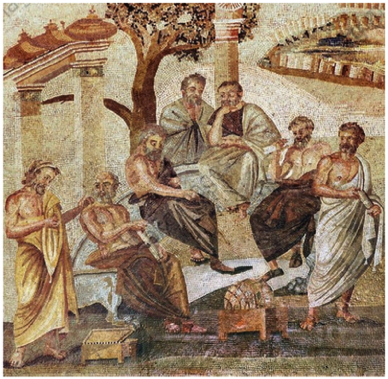
Plato’s Academy in Athens from a Roman mosaic in Pompeii, c. 70 AD. Left to right interpreted as: Heraclides, Ponticus, Lysis, Plato, unknown, unknown, Xenocrates, and Aristotle.
Naples, Biblioteca Nazionale.
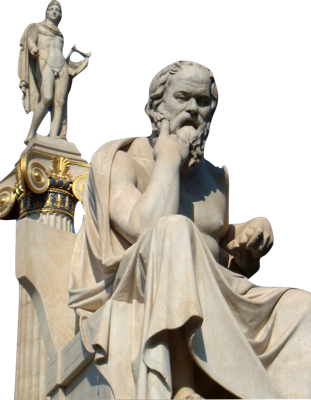
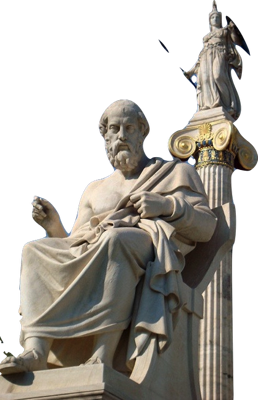
From the modern-day Academy in Athens, LEFT: Apollo, who declared Socrates the wisest of men, looks over his shoulder. RIGHT: Athena, fully-armed for spiritual battle, looks over Plato’s shoulder.
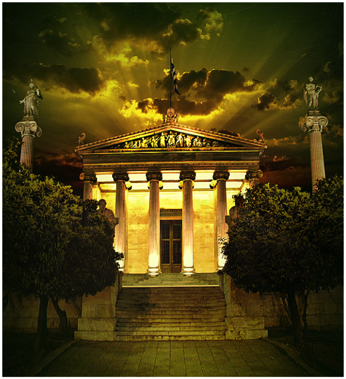
The modern Academy of Athens established in 1926 to provide scientific and cultural advice to the state honors its legacy as it features statues of Athena, Apollo, Plato and Socrates.
We have seen that the source of religious enchantment is the ancient Genesis serpent (serpent in Hebrew = enchanter), that ancient Greek sculptors openly depicted Greeks worshiping the serpent, that it is Satan who spoke through the Genesis serpent, that the Greeks depicted the ancient serpent being transfigured into Zeus becoming a guise of Satan himself, and further, that Athena, having come into being full-grown and fully armed for spiritual battle out of the mind of Zeus/Satan became the operative power and “wisdom” of Satan in the post-Flood world.
Athena inspired two of her worshipers, Socrates and Plato, to exalt the reasoning and wisdom of men and embrace philosophy. The writings of Plato provide us with an understanding of that philosophy’s essence⏤its basic, real, and invariable nature. It consists of three dominant elements: enchantment, elitism, and hypocrisy. These three basic elements of Platonism became interwoven into early Christianity transforming it into Christendom.
Socrates and Plato were not true teachers but rather, like the goddess Athena they worshipped, enchanters. Socrates and Plato reveal in their own words that they are enchanters; in fact, Plato wrote that genuine philosophers must follow a path of enchantment. Theologians are religious philosophers, therefore, they too must follow "a path of enchantment."
Christ gives to the chosen members of His body evangelists, pastors, and teachers (Ephesians 4:11). To Christendom, Athena gives enchanters and gospelizers instead of teachers and evangelists.
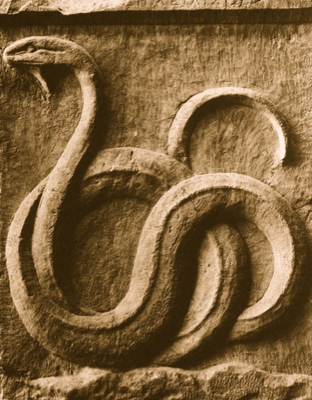
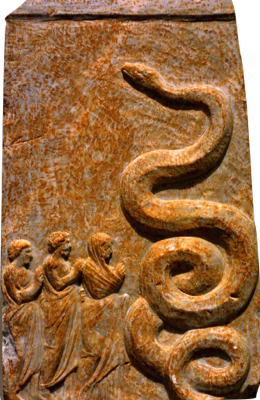
These reliefs found at Athens harbor date from 350 BC. Left, inscribed above the coiled beast is “to Zeus Meilichios” meaning “to Zeus the easily entreated one.” Right, a woman and two men approach Zeus Meilichios depicted as the serpent with gestures of piety and adoration.