The Divine Comedy, a long Italian narrative poem completed by Dante Alighieri in 1320, is widely considered to be the pre-eminent work in Italian literature, even one of the greatest works in all of world literature. The poem presents a vision of the afterlife based upon the eternal cosmic horror story developed by the RCC. Divided into three parts, the narrative describes Dante's travels through the Inferno (Hell) Purgatory and Paradise (or Heaven). Dante draws on the Christian theology of Augustine and especially the philosophy (“heap of straw”) of Thomas Aquinas. Dante presents the Latin writer Virgil⏤his guide⏤as representing human reason and Beatrice as representing philosophy.
Sometime after Dante’s death in 1321, an artist known as Master of the Antiphonary (liturgical chants) of Padua, produced an illuminated manuscript of Dante’s Divine Comedy, consisting of 261 miniatures in colors and gold, now in the British Library. Illustrations on the following pages from the manuscript reveal how profoundly Zeus-religion, including its unscriptural views of the afterlife, influenced the doctrines of the RCC, Protestantism, and to this day, the general public.
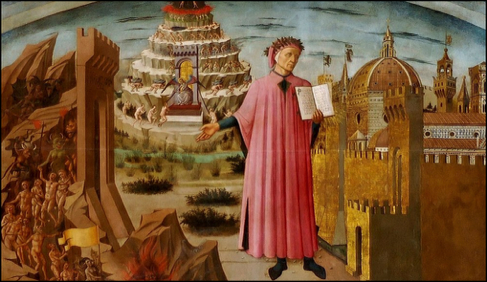
Domenico di Michelino’s fresco (c. 1450), on the west wall of Florence’s Cathedral Santa Maria del Fiore, shows Dante holding a copy of the Divine Comedy, with the entrance to Hell to his right, and behind him the seven terraces of Mount Purgatory and the city of Florence, with the spheres of Heaven above.
DANTE MERGES SATANIC GREEK RELIGION WITH SCRIPTURE
CHARON’S FERRY BECOMES PART OF DANTE’S HELL
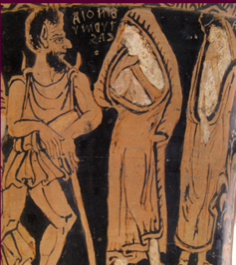
In Greek myth, Charon ferried the dead across the river into the underworld. Left: Charon (Etruscan demon of death) with dead souls, c. 310 BC.
Right: On a funerary oil flask from about 450 BC, Hermes, identifiable by his herald's staff, looks over his shoulder and beckons a young man, the deceased (out of view), toward Charon's boat.
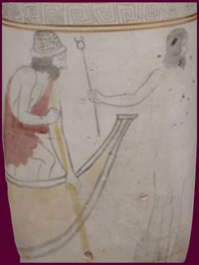
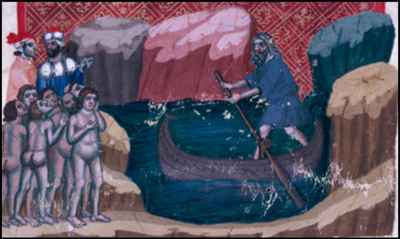
From the illuminated manuscript: Virgil and Dante observe souls waiting for Charon’s ferry to carry them to eternal torment. In the 1st century BC, the Roman poet Virgil, Dante’s companion, had described Charon in detail in Book 6 of his Aeneid. Charon is the first of many mythological characters Dante meets in the underworld. Greeks named the river the Acheron; the Romans called it the Styx.
DANTE BORROWS THE FURIES OF GREEK MYTH TO INFLICT TORTURE IN HIS MADE-UP HELL
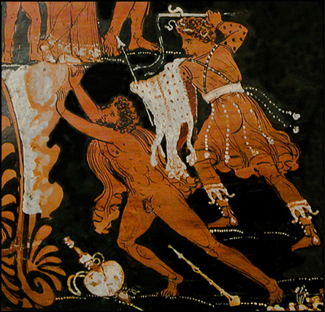
The Furies, servants of Hades and Persephone in the underworld, oversaw the torture of criminals consigned to the Dungeons of the Damned. From a vase-painting c. 320 BC depicting Heracles' journey to the underworld, one of the Furies torments Sisyphus with a whip as he seeks to roll the stone up the hill only to have it fall back to the bottom each time he nears the top.
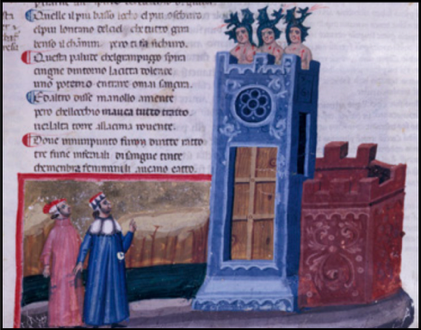
From the illuminated manuscript: Virgil and Dante look up at the bloodstained Furies at the top of a tower.