ATHENA'S SPELL
THE RIDDLE, THE TABOO AND THE THREAT
An idol is an image by means of which human senses are supposed to be able to perceive the whole character of the deity. Athena’s idol-image is the very embodiment of the Athanasian Creed’s ancient spell consisting of a riddle, taboo, and a threat. The demonic spirit behind Athena’s gold and ivory Parthenon idol-image is the very source of that enchanting spell.
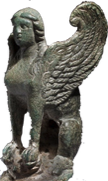
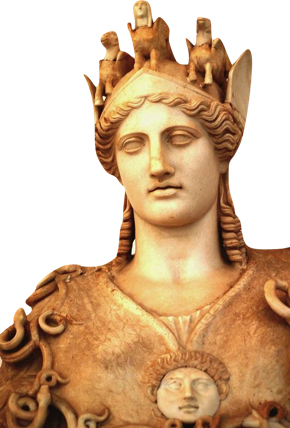
For the top of the helmet of her Parthenon idol-image, the sculptor, Phidias, chose a sphinx, that well-known ancient symbol of riddles.
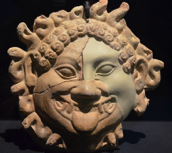
On her chest, he placed a Gorgon Medusa, a warning to all that questioning the goddess is forbidden, or taboo.
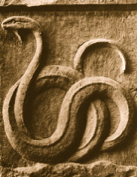
Inside her shield, he placed a fearsome threat: the coiled serpent ready to strike.
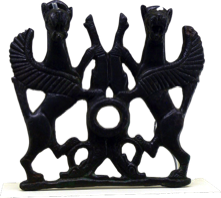
So there we have symbols of the riddle, taboo, and threat making up the spell of the Athanasian Creed. But the ancient sculptor, Phidias, didn’t leave it at that. On both sides of the sphinx, he placed a gryphon to protect the gold.
According to Hans Biedermann’s Dictionary of Symbolism, the gryphon was known for “entrapping human souls.”
Athena receives her enchanting power from the Genesis serpent whose root name in Hebrew is nâchash meaning “to hiss, i.e. whisper a (magic) spell . . . enchanter.” The Athanasian Creed is Athena's Creed.
Sphinx,
c. 500 BC
RIDDLE
Gorgoneion,
c. 520 BC
TABOO
Coiled Serpent,
c. 350 BC
THREAT
Bronze Gryphons from
1st millennium BC.
SOUL ENTRAPMENT
Athena Farnese, c. 150 AD. Roman copy of a Greek original. On Athena’s helmet, two Gryphons, symbolizing the entrapment of human souls, flank the sphinx, a symbol of riddles.
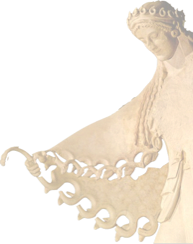
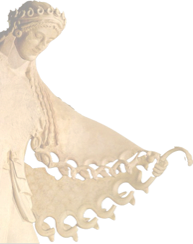
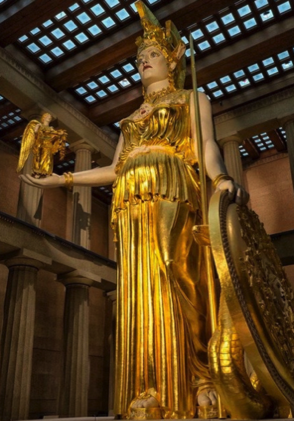
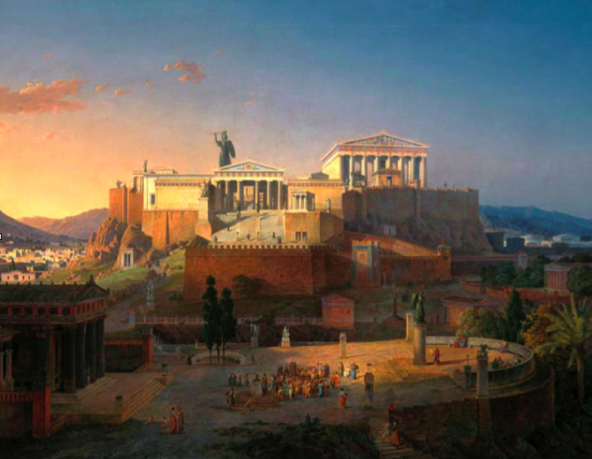
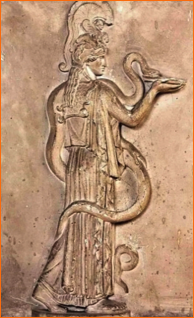
On the Acropolis of ancient Athens stood the Parthenon, a glorious temple to a woman we commonly call Athena. Outside her temple stood a huge bronze statue of her in warrior mode. Inside her temple stood her 40-foot-tall gold and ivory idol-image. In her right hand, she holds Nike, or Victory. By her left side, the golden Genesis serpent rises up next to her. This is the woman whose friendship with the serpent has led to humanity's victory over Noah and his God-fearing offspring in the post-Flood world.
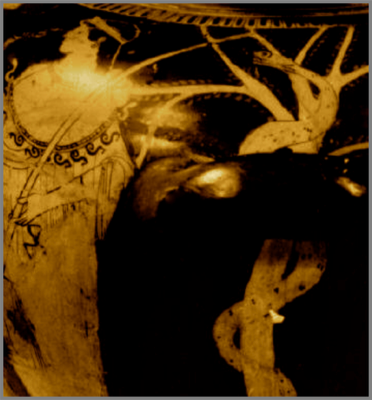
In this rare and revealing vase-painting from 450 BC, Athena, identified by her serpent-trimmed aegis, stands proudly next to the serpent-entwined apple tree. The serpent appears to be giving her instructions.
Athena inspired the following demonic creed of Christendom. The source of her inspiration, as the vase clearly shows, is the ancient serpent of Genesis, called Adversary and Satan (Revelation 12:9).
THE RIDDLE, THE TABOO AND THE THREAT MAKING UP THE SPELL
AS EXPRESSED IN THE RCC'S:
ATHANASIAN CREED
Whoever will be saved: before all things it is necessary that he hold the Catholic Faith. Unless he keep this Faith whole and undefiled, without doubt he shall perish everlastingly. [THE FIRST OF FOUR EXPRESSIONS OF THE THREAT].
And the Catholic Faith is this: we worship one God in Trinity, and Trinity in Unity, neither confounding the Persons, nor dividing the Substance. For there is one Person of the Father, another of the Son, another of the Holy Ghost. But the Godhead of the Father, of the Son, and of the Holy Ghost is all one: the Glory co-equal, the Majesty co-eternal. Such as the Father is, such is the Son, and such is the Holy Ghost. The Father uncreated, the Son uncreated, and the Holy Ghost uncreated. The Father incomprehensible, the Son incomprehensible, and the Holy Ghost incomprehensible. The Father eternal, the Son eternal, and the Holy Ghost eternal. And yet they are not three eternal, but one Eternal. As also there are not three incomprehensibles, nor three uncreated, but one uncreated and one incomprehensible. So likewise the Father is almighty, the Son almighty, and the Holy Ghost almighty; and yet they are not three almighties, but one Almighty. So the Father is God, the Son is God, and the Holy Ghost is God; and yet they are not three gods, but one God. [THIS IS THE RIDDLE: HOW CAN ONE BE THREE AND THREE BE ONE?]
So likewise the Father is Lord, the Son Lord and the Holy Ghost Lord; and yet not three lords, but one Lord [A REPETITION OF THE RIDDLE]. For like as we are compelled by the Christian truth to acknowledge every Person by Himself to be God and Lord, so we are forbidden by the Catholic religion to say, there are three gods or three lords. [THIS IS THE TABOO].
The Father is made of none, neither created nor begotten. The Son is of the Father alone, not made, nor created, but begotten. The Holy Ghost is of the Father and of the Son, neither made, nor created nor begotten, but proceeding. So there is one Father, not three Fathers, one Son, not three Sons, one Holy Ghost, not three Holy Ghosts.
And in this Trinity none is before or after the other; none is the greater or less than another; but the whole three Persons are co-eternal together, and co-equal; so that in all things the Unity in Trinity, and the Trinity in Unity is to be worshipped. He therefore that will be saved must thus think of the Trinity. [THIS IS THE SECOND EXPRESSION OF THE THREAT].
Furthermore, it is necessary to everlasting salvation that he also believe rightly in the Incarnation of our Lord Jesus Christ. For the right Faith is, that we believe and confess that our Lord Jesus Christ, the Son of God, is God and Man: God, of the Substance of the Father, begotten before the worlds: and Man, of the Substance of His mother, born in the world: Perfect God and perfect Man: of a reasonable soul and human flesh subsisting: equal to the Father, as touching His Godhead, and inferior to the Father, as touching His Manhood. Who although He be God and Man, yet He is not two, but one Christ: One, not by conversion of the Godhead into flesh, but by the taking of the Manhood into God. One altogether is Jesus Christ, not by confusion of Substance, but by unity of Person. For as the reasonable soul and flesh is one man, so God and Man is one Christ. He suffered for our salvation, descended into hell, rose again the third day from the dead. He ascended into heaven, sitteth at the right hand of the Father, God Almighty, from whence He shall come to judge the living and the dead.
At His coming all men shall rise again with their bodies and shall give account for their own works. They that have done good shall go to life everlasting, and they that have done evil into everlasting fire. [THIS IS THE THIRD EXPRESSION OF THE THREAT].
This is the Catholic Faith. Unless a man believe it faithfully, he cannot be saved. [THIS IS THE FOURTH EXPRESSION OF THE THREAT].
______