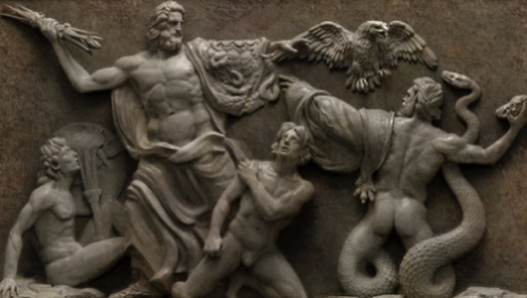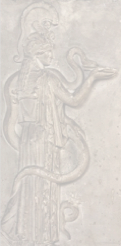
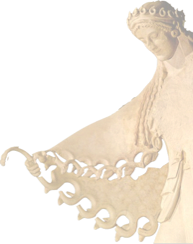
Artist’s reconstruction on the scene on the altar of Zeus with Zeus crushing the Giants, the God-fearing sons of Noah (Seth-men). The legs of the Seth-man to the right turn into serpents, making him unable to stand and fight Zeus.
When we examine the artist’s reconstruction of the scene with Zeus, above, and the scene with Athena, below, we note that it is not Zeus, the king of the gods (the deification of the first man, Adam, the progenitor of all mankind) who is crowned, but rather it is Athena who receives the wreath of triumph from Nike. Why is that? The victory of Adam/Zeus took place in the ancient garden when he and Eve welcomed the serpent’s “enlightenment.” The sculptures on the Altar of Zeus/Throne of Satan boast of the triumph of the way of Cain in post-Flood world, and it was Naamah/Athena who inspired and led that post-Flood rebellion on behalf of her father Zeus/Satan and the way of Cain.
Thus Athena is the idol-image of the demonic spirit of this present wicked eon (Galations 1:4).
As a created being, Zeus/Satan is not an originator of spiritual things, but rather an imitator of God’s operations. Just as Jesus Christ is the “wisdom of God and the power of God,” so Athena is the wisdom of Satan and the power of Satan.
Just as Christ came out of God, so we shall see that Greek vase artists made it very clear that Athena came out of Zeus/Satan.
NIKE CROWNS ATHENA AS VICTORIOUS ON THE THRONE/ALTAR OF HER FATHER ZEUS/SATAN
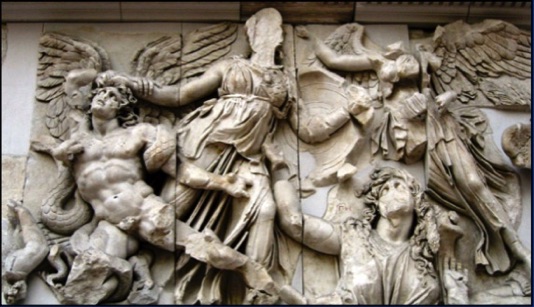
From the east frieze, Nike approaches Athena from our right to crown her as victorious as she and the serpent bring down the winged Seth-man Enkelados. Athena drives his head downward as the serpent, entwined about his body with fangs locked into his breast, pulls him to the earth.
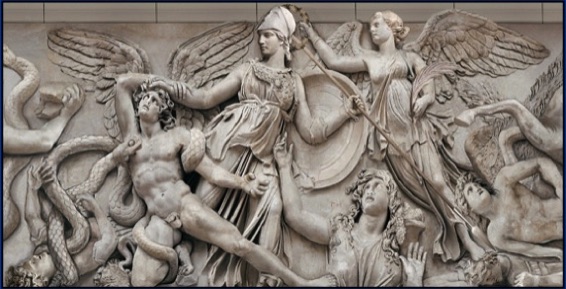
Artist’s reconstruction of the scene above. Nike crowns Athena as the wisdom and power of Zeus/Satan
ON THE ALTAR OF ZEUS/SATAN, THE ARTISTS SCULPTED NOAH AS A DEJECTED WITNESS TO ATHENA’S POST-FLOOD TRIUMPH
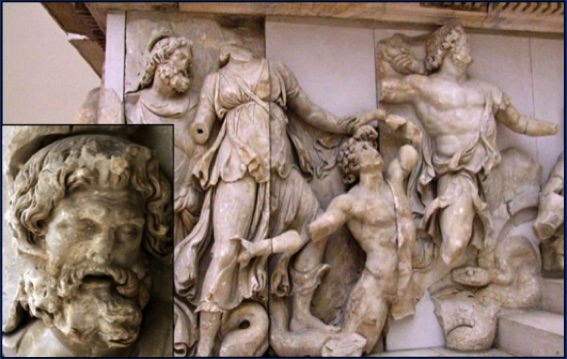
Look at the old man to the left on this part of the frieze. His face is solemn and sad, and he is the only living male on the entire frieze who is not actively engaged in the battle. From one of the corners, the sculptors have made him an observer of this horrendous defeat of the line of Seth.
This is Nereus, the Greek Noah. Greek religious art chronicles the great post-Flood spiritual change that took place after the Flood. Greek artists often used Noah/Nereus as a constant against whom they were able to portray this great change. This device was artistically effective and historically accurate.
Next to Nereus stands his wife, Doris, unnamed in Genesis. She reaches out to lift one of her sons by his hair as his legs of are turning into serpents—signifying that he is no longer has firm legs upon which he can stand and fight the onslaught of Zeus-religion.
From the point of view of Scripture, Noah and his wife are forced to witness an “abomination of desolation.” Recognition of the Creator of the universe ends, and humanity elevates and worships Zeus/Satan and Athena, the glorified Cainite woman Naamah, who came through the Flood as Ham’s wife and inspired the post-Flood rebellion.