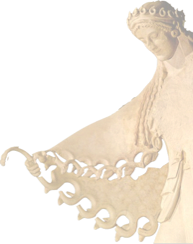

While in Athens during his second missionary journey, c. 50 AD, the apostle Paul’s spirit became “incited in him at beholding the city being idol-ridden” (Acts 17:16). The Greek word translated incited is paroxuno, literally beside-sharpened. It is beyond question that Paul examined the outer sculptures of the Parthenon and stood before Athena’s gigantic idol-image inside. Athena and the other idols sharpened and stirred him to reveal, by contrast with them, the true God Whom he heralded “in the market on every day with those happening along” (17:7).
Six years later, in his epistle to the Romans written from Corinth during his third missionary journey, Paul described the foolishness of abandoning God in favor of Athena thus: “knowing God, not as God do they glorify or thank Him, but vain were they made in their reasonings, and darkened is their unintelligent heart. Alleging themselves to be wise, they are made stupid, and they change the glory of the incorruptible God into the likeness of an image of a corruptible human being and flying creatures and quadrupeds and reptiles” (Romans 1:18-20).
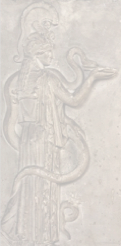
Athena’s Parthenon idol-image indeed depicted an image of “a corruptible human being,” the deified Cainite princess Naamah. The “flying creatures and quadrupeds” were the sphinx and the gryphons atop Athena’s helmet. The “reptiles” Paul discerned on the enormous idol-image were the huge serpent inside Athena’s shield coiled to strike, and the snakes on the head of the Gorgon Medusa.
About a year before writing Romans, Paul had written Second Corinthians wherein he described Athena, as “the god of this eon [who] blinds the apprehensions of the unbelieving so that the illumination of the evangel of the glory of Christ, Who is the image of the invisible God, does not irradiate them” (II Corinthians 4:4).
Paul’s encounter with Apollo’s python spirit in chapter 16 of the Book of Acts foreshadowed early Christianity’s takeover by Zeus-religion. A python snake completely ingests prey as large as a human. Figuratively, within three centuries of Paul’s time, the python spirit had swallowed most of Christianity whole.
The glorious risen Christ commissioned Paul as His herald, apostle and teacher of the nations in knowledge and truth (I Timothy 2:7). Paul wrote that “the wisdom of this world is stupidity with God,” and that “The Lord knows the reasonings of the wise, that they are vain” (I Corinthians 19:20-21). Paul warned about philosophy and empty seduction stealing the truth from believers (Colossians 2:8).