The RCC’s most prominent “church father,” Augustine (354 - 430), using Plato’s sketchy dialectical method of thinking, contradicted Paul’s Christ-commissioned teaching with his three key unscriptural doctrines: (1) eternal torment for most of humanity (even babies), (2) salvation by human “free will,” and (3) a self-admitted incomprehensible trinity of co-equal and co-eternal “persons,” philosophically contrived. Augustine borrowed his eternal torment teaching from Greek myth, changing the character of God’s love for mankind from unconditional to conditional in the most evil extreme.
A Platonic philosopher turned theologian, he concluded his religious career as the Bishop of Hippo in Roman North Africa. His writings cemented into the RCC, as essential and inviolable doctrine, the burgeoning unscriptural teaching of three mysterious co-equal persons, salvation through one’s own will, and endless torture for unbelievers.
Augustine’s Incomprehensible Trinity
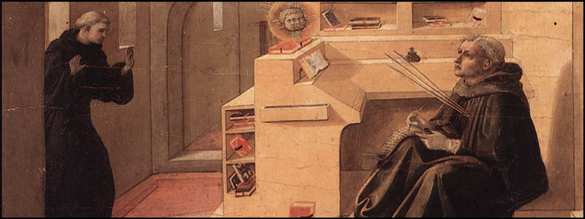
Augustine Perceives the Trinity. Note the three faces in the top center of the painting.
Fra Filippo Lippi, c. 1438. Tempera on wood, Galleria degli Uffizi, Florence.
Augustine wrote his The Trinity over a period of twenty years. It included fifteen different books, and ended with a text so massive that it was published in parts, as a draft, and later revised by Augustine.
In his final trinity book, he endeavored to explain his obsession:
Why search for something when you have comprehended the incomprehensibility of what you are searching for? Only this: because you should not give up the search as long as you are making progress in the search itself for things incomprehensible, and because you are becoming better and better by searching for so great a good, which is both searched for in order to be found and is found in order to be searched for. For it is both searched for in order that it may be found sweeter, and found in order that it may be searched for all the more eagerly. (Trinity 15:2.2, Augustine in His Own Words by W. Harmless, 2010, p. 314).
Today, we call such obtuse writing a word salad. Augustine played a key part in the codifying and promotion of an unscriptural and illogical philosophical construct, then spent twenty years trying to explain it, and then concluded his explanation by writing that it cannot be explained⏤and then maintained that’s a good thing! This is one example of what Paul called “empty seduction!” What it comes down to is this: Augustine, the philosopher, took Plato’s advice and set out for himself a “path of enchantment” instead of believing what God revealed through His Christ-commissioned apostle Paul. Augustine’s excuse for not being able to explain his trinity reminds me of the Jesuit author who counted it a big plus that no one knows when or by whom the “ingeniously contrived” Athanasian Creed was written.
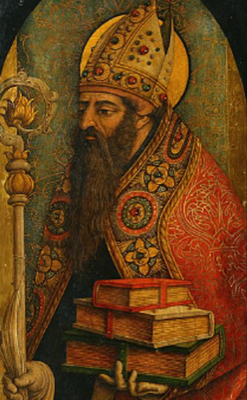
St. Augustine by
Carlo Crivelli c. 1475